

Losing a family member because of someone else's negligence is devastating. If you are wondering whether you have the legal right to file a wrongful death lawsuit in Kansas, the answer depends on your relationship to the deceased and your status as an "heir at law" under Kansas statutes. Kansas law does not allow just anyone to bring a wrongful death claim. Instead, it limits standing to specific individuals defined by the state's intestate succession rules. This guide explains exactly who qualifies, how the process works, and what deadlines you must meet to protect your family's rights.
Kansas Wrongful Death Statute Overview
Kansas wrongful death claims are governed by K.S.A. 60-1901 through 60-1906. Under K.S.A. 60-1901, a wrongful death occurs when "the death of a person is caused by the wrongful act or omission of another." A wrongful death claim is a civil lawsuit, separate from any criminal proceedings, that allows surviving family members to seek compensation for their losses.
The statute creates a right of action whenever the deceased person could have maintained a personal injury lawsuit had they survived. This means wrongful death claims can arise from semi-truck collisions, airplane and helicopter crashes, carbon monoxide poisoning, and other catastrophic events caused by negligence or intentional misconduct.
Who Qualifies as an Heir at Law in Kansas
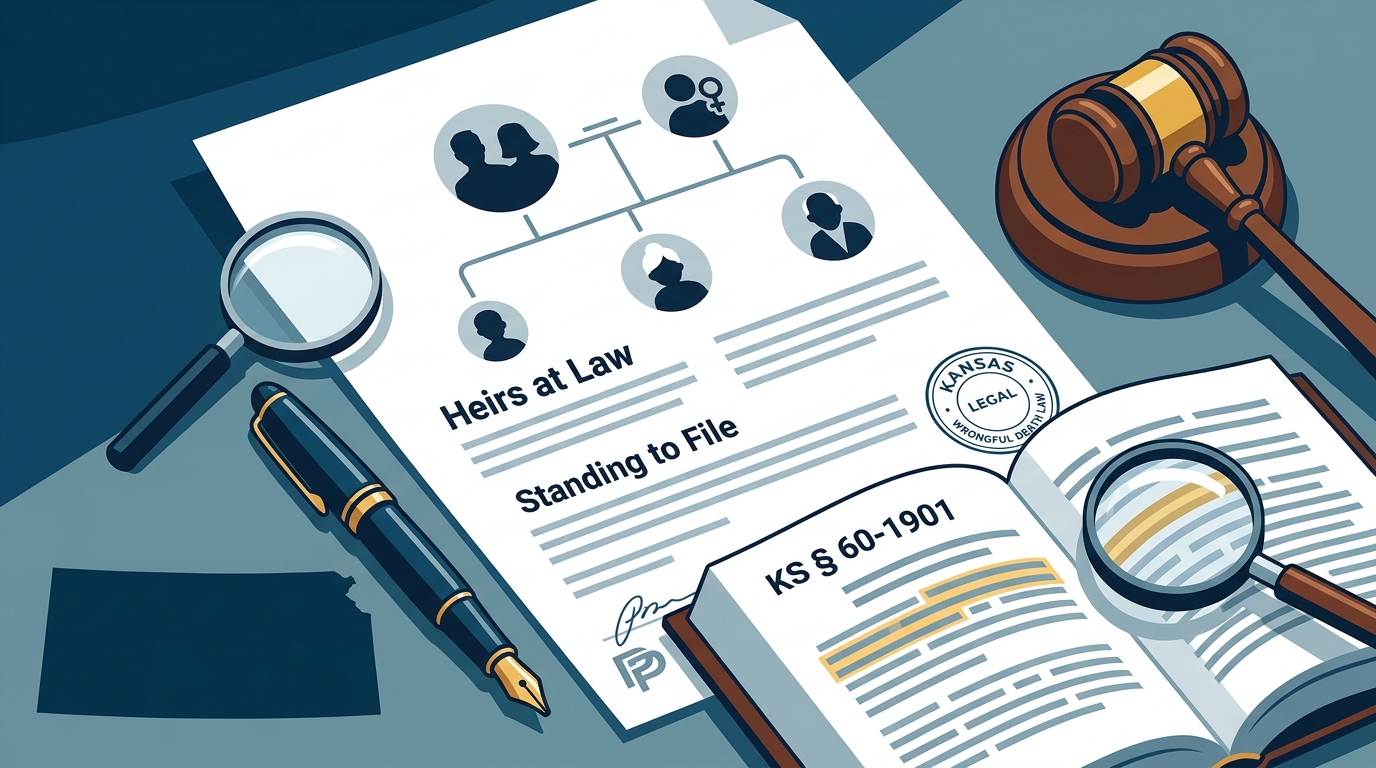
Under K.S.A. 60-1902, only "heirs at law" of the deceased may commence a wrongful death action. An heir at law is a person entitled to inherit from the deceased under Kansas intestate succession statutes, meaning they would receive property if the person died without a will. This definition is critical because it limits who has legal standing.
Unlike some states that allow a personal representative of the estate to file on behalf of all beneficiaries, Kansas permits any single qualifying heir to initiate the lawsuit. However, a biological relationship alone is not sufficient. The heir must also demonstrate they sustained an actual loss because of the death.
Important Distinction: Heirs vs. Beneficiaries
Kansas courts have consistently held that "heir" and "heir at law" are synonymous terms referring to those who take by intestate succession. If the deceased left a surviving spouse or children, parents and siblings are generally excluded from heir status under Kansas law. This can create situations where a parent cannot file a wrongful death lawsuit for an adult child who was married at the time of death.
Priority Order of Eligible Filers
Kansas intestate succession law (K.S.A. 59-504 through 59-508) establishes a hierarchy that determines who qualifies as an heir at law. The following table outlines the general order of priority:
| Priority Level | Eligible Heir | Conditions |
|---|---|---|
| 1 | Surviving Spouse | Inherits all property if no surviving children; shares with children if any exist |
| 2 | Children (biological or adopted) | Share equally; inherit all if no surviving spouse |
| 3 | Parents | Eligible only if decedent left no spouse, children, or issue |
| 4 | Siblings | Eligible only if no spouse, children, issue, or parents survive |
| 5 | Grandparents and Extended Family | Eligible in rare cases where no closer heirs exist |
Kansas courts have confirmed that a surviving spouse of a childless deceased person is the sole heir and holds the exclusive right to bring a wrongful death action. Similarly, surviving siblings cannot qualify as heirs at law while the decedent's parents are alive.
How Other Heirs Can Join the Lawsuit
Only one wrongful death lawsuit may be filed per death in Kansas. However, the law provides a mechanism for additional heirs to participate. Under K.S.A. 60-1902, any heir who does not join as a party plaintiff in the original action may intervene if they claim to have been damaged by the death.
The action benefits all heirs who sustained a loss, regardless of whether they actively participate in the lawsuit. If surviving heirs cannot agree on how to divide recovery proceeds, the presiding judge will allocate them based on factors such as each heir's relationship to the deceased, their financial dependence, and the degree of loss suffered.
Wrongful Death vs. Survival Actions
A survival action is a separate legal claim that compensates the deceased person's estate for losses sustained between the date of injury and the date of death. The personal representative of the estate files the survival action, not the heirs at law. Understanding the difference between these two types of claims is essential for maximizing total recovery.
Key Differences at a Glance
| Feature | Wrongful Death Action | Survival Action |
|---|---|---|
| Who Files | Heirs at law | Personal representative of the estate |
| Compensates For | Heirs' losses after death (lost income, companionship, emotional distress) | Decedent's losses before death (medical bills, pain and suffering) |
| Governing Statute | K.S.A. 60-1902 | K.S.A. 60-1801 |
In many wrongful death cases, both types of claims are filed together. An experienced attorney can ensure both avenues of compensation are pursued. Presley and Presley Trial Lawyers, recognized as a Tier 1 firm for Personal Injury Litigation by Best Lawyers 2026, has recovered $30 million in a single wrongful death case involving carbon monoxide exposure.
Kansas Statute of Limitations and Damages
Under K.S.A. 60-513, a Kansas wrongful death lawsuit must be filed within two years of the date of death. Missing this deadline almost certainly results in the court dismissing the case, regardless of its merits. Limited exceptions exist under the discovery rule when the cause of death was not immediately apparent.
Available Damages
Kansas wrongful death damages include medical and funeral expenses, lost income and future earnings, loss of companionship, and emotional distress. There is no cap on economic (pecuniary) damages. However, non-economic damages are capped at $250,000 in the aggregate under K.S.A. 60-1903.
Kansas also follows a modified comparative negligence rule. If the deceased was 50% or more at fault for the incident, the family may be barred from recovering any damages. An attorney experienced in insurance bad faith litigation can counter insurer tactics designed to shift blame onto the victim.
Key Takeaways
- Only "heirs at law" as defined by Kansas intestate succession rules may file a wrongful death lawsuit under K.S.A. 60-1902.
- A surviving spouse and children hold the highest priority; parents and siblings qualify only when no closer heirs exist.
- Any single qualifying heir can initiate the lawsuit; other heirs may intervene.
- The lawsuit benefits all heirs who sustained a loss, even those who do not actively participate.
- Kansas imposes a strict two-year statute of limitations from the date of death.
- Non-economic damages are capped at $250,000, but there is no limit on economic damages.
- A survival action is a separate claim filed by the estate's personal representative for pre-death losses.
Frequently Asked Questions
Can a parent file a wrongful death lawsuit for an adult child in Kansas?
Only if the adult child had no surviving spouse or children. Under Kansas intestate succession rules, parents become heirs at law only when no spouse or issue survives the decedent.
Can siblings file a wrongful death claim in Kansas?
Siblings may qualify as heirs at law only if the deceased left no surviving spouse, children, or parents. Kansas courts have held that siblings are not heirs at law while parents are alive.
Does the executor of a will automatically have the right to file?
No. The executor does not automatically gain standing to file a wrongful death claim. However, if no next of kin can file, the executor may be permitted to bring the action.
What is the deadline for filing a wrongful death lawsuit in Kansas?
The statute of limitations is two years from the date of death under K.S.A. 60-513. In rare circumstances, the discovery rule may extend this period if the cause of death was not immediately known.
Can multiple family members file separate wrongful death lawsuits?
No. Kansas law limits wrongful death to a single claim per death. However, all eligible heirs may join or intervene in that single lawsuit and share in the recovery.
What damages are available in a Kansas wrongful death case?
Families may recover medical and funeral expenses, lost income and future earnings, loss of companionship, and emotional distress. Non-economic damages are capped at $250,000, while economic damages have no statutory limit.
How is the recovery divided among heirs?
If heirs cannot agree, the court allocates proceeds based on each heir's relationship to the deceased, financial dependence, and the extent of their individual loss.
Is a wrongful death lawsuit the same as a survival action?
No. A wrongful death action compensates heirs for losses after the death. A survival action compensates the estate for the decedent's losses between the injury and death. Both may be filed in connection with the same incident.
Speak With a Kansas City Wrongful Death Lawyer
If you have lost a loved one due to negligence in a car accident, motorcycle crash, workplace explosion, or any other preventable tragedy, time is limited. Kansas gives you only two years to file. Presley and Presley Trial Lawyers, LLC, a Best Lawyers 2026 Tier 1 ranked firm for Personal Injury Litigation in Kansas City, has over 40 years of experience and has won millions for grieving families, including a $30 million wrongful death recovery. Kirk Presley and Jill Presley, named 2026 Aviation Lawyer of the Year by Best Lawyers, provide the skilled, compassionate representation your family needs.
Contact Presley and Presley Trial Lawyers at (816) 931-4611 for a free consultation. Every wrongful death case is handled on a contingency fee basis, so you pay nothing unless we win.