

When a commercial truck or transportation vehicle causes a catastrophic collision, determining who is at fault requires far more than reading a police report. Legal teams must move quickly, dig deep into corporate records, and piece together a web of regulatory violations, mechanical failures, and human errors. This guide walks through every phase of the investigation process so you understand what happens behind the scenes when attorneys build a negligence case after a trucking accident.
Why Trucking Accident Investigations Differ from Car Crashes
A collision involving a commercial truck is fundamentally different from a standard fender-bender. The sheer mass of an 80,000-pound fully loaded semi means injuries are almost always more severe. But beyond physics, the legal landscape is vastly more complicated.
In a typical two-vehicle car accident, liability often rests with one driver and one insurance policy. In a commercial truck crash, there is frequently a corporate legal team, a liability adjuster, and a third-party safety consultant all working before the road is even clear. That means the injured party needs equally aggressive representation to level the playing field.
Federal regulations from the Federal Motor Carrier Safety Administration (FMCSA) add layers of compliance requirements that simply do not exist for passenger vehicles. These regulations cover vehicle maintenance, hours of service, cargo securement, driver qualification standards, and drug and alcohol testing. Violations of any of these rules can form the foundation of a negligence claim.
The Four Legal Elements of Negligence
Before examining investigative techniques, it helps to understand what a legal team must ultimately prove. Every trucking negligence case rests on four pillars:
- Duty of Care — The truck driver and trucking company have a legal obligation to operate safely and comply with federal and state laws to prevent harm to others on the road.
- Breach of Duty — The responsible party violated this duty through negligent actions such as speeding, fatigued driving, or improper vehicle maintenance.
- Causation — The breach of duty directly caused the accident and resulted in injuries or wrongful death.
- Damages — The victim suffered measurable losses including medical expenses, lost wages, pain and suffering, and other harms.
Every phase of the investigation is designed to gather evidence supporting one or more of these elements.
Phase 1: Rapid Evidence Preservation
Speed is the single most important factor in the earliest stage of a trucking accident investigation. Evidence in these cases can disappear, degrade, or be destroyed within hours. Trucking companies routinely send their own investigators to the crash scene immediately—sometimes arriving before police—to gather evidence that protects their drivers and limits corporate exposure.
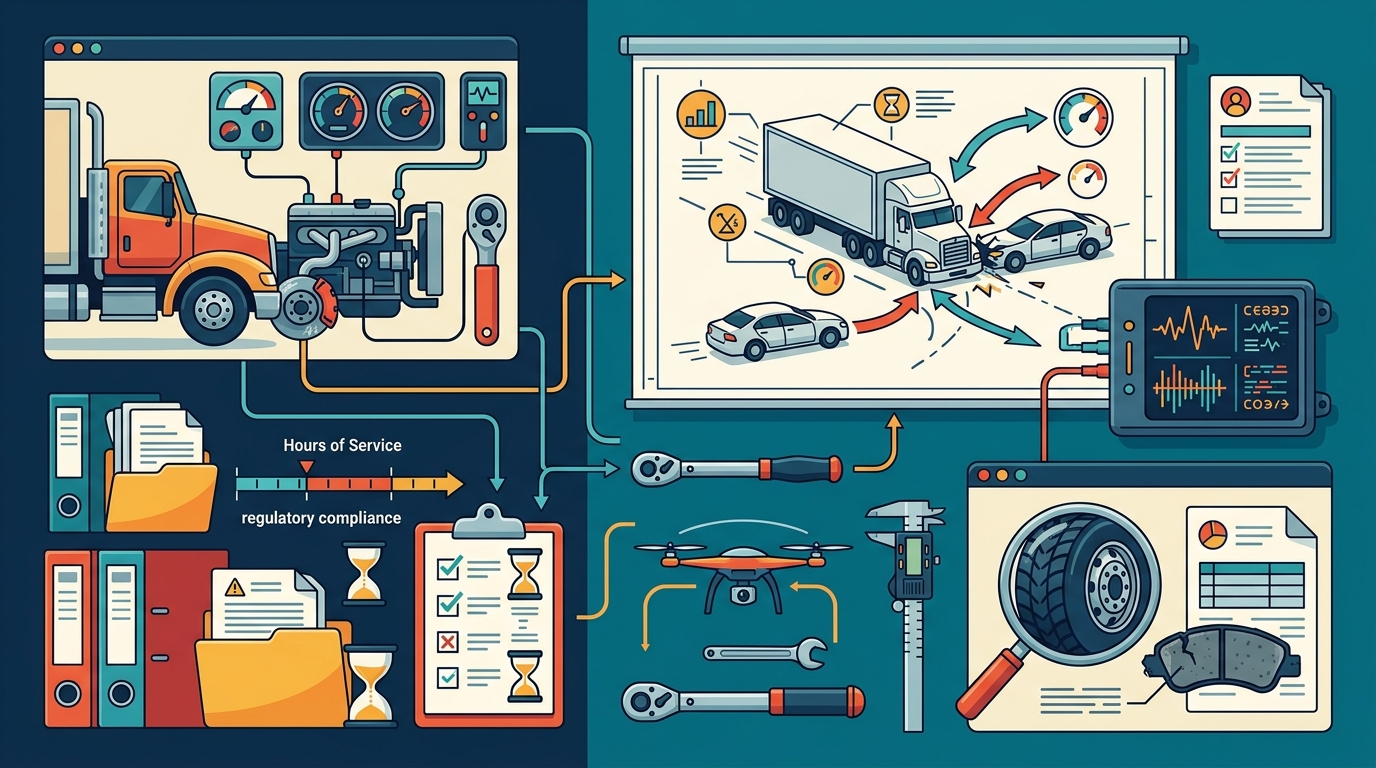
The Spoliation Letter
One of the first actions a qualified attorney takes is drafting and sending a spoliation letter (also called a preservation letter). This formal legal demand is sent to the carrier and its insurer requiring preservation of all crash-related evidence. The letter specifically identifies electronic control module (ECM) data, electronic logging device (ELD) records, dashcam footage, GPS logs, driver qualification files, maintenance records, and post-crash drug test results.
A spoliation letter should go out within 48 to 72 hours of the crash. Evidence destroyed after a spoliation demand has been received can be used against the carrier at trial, and courts may impose sanctions or adverse inference instructions on parties who fail to comply.
Temporary Restraining Orders
In some cases, attorneys seek a temporary restraining order from the court to prevent the trucking company from repairing the vehicle, overwriting digital data, or otherwise altering evidence before it can be independently inspected.
Phase 2: Crash Scene Investigation
While the spoliation letter secures corporate records, the legal team simultaneously dispatches investigators to the physical crash site. Their objectives include:
- Photographing and videotaping everything — Vehicle damage from every angle, skid marks, debris fields, road surface conditions, traffic signals, and signage.
- Documenting the truck itself — The DOT number, license plate, company name, and trailer markings. The US DOT number on the driver-side door is particularly important because it enables the legal team to access the driver's name, address, insurance information, and carrier details through FMCSA databases.
- Collecting witness information — Eyewitnesses can provide testimony about what they saw and heard before and after the crash, including details about signals, weather, and driver behavior. Witness statements are particularly powerful because they come from neutral parties.
- Reviewing nearby surveillance — Traffic cameras and private security cameras in the surrounding area may have captured footage showing the accident in real time.
Commercial truck crash scenes are cleared faster than standard accidents, and physical evidence that is gone is gone permanently. That urgency drives the need for rapid deployment of independent investigators.
Phase 3: Extracting Electronic and Digital Data
Modern commercial trucks are data-rich machines. The electronic evidence they generate often tells a more objective story than any witness account.
Event Data Recorders (Black Boxes)
A commercial truck event data recorder can log speed, brake application, throttle position, engine RPM, seat belt use, steering input, cruise control status, and sudden changes in motion. Depending on the truck and system, it may also store hard-braking events, diagnostic trouble codes, hours-of-service-related inputs, and the timing of mechanical warnings.
This data provides an objective snapshot of how the vehicle performed during critical moments. However, because black box data can be overwritten or lost soon after a crash, prompt legal action to preserve it is essential.
Electronic Logging Devices (ELDs)
ELDs record driving hours, speed, and performance data. Examining these logs can reveal violations such as exceeding permissible hours of driving time. The difference between actual activity and required rest breaks will indicate either fatigue or a regulatory violation—both of which are powerful evidence of negligence.
Cross-Referencing Records
Experienced legal teams know that paper logs and electronic logs can both be falsified. That is why cross-referencing them against fuel receipts, toll records, GPS data, and weigh station records is a standard part of a thorough investigation. Discrepancies between different records can reveal that a driver was behind the wheel longer than their logs indicate.
Phase 4: Corporate Records and Regulatory Compliance Review
The investigation extends well beyond the truck and the driver. A thorough legal team subpoenas the trucking company's internal records to uncover systemic failures.
Driver Qualification Files
Company records reveal hiring practices, training history, and any prior complaints or safety violations involving the driver. If a trucking company continued to employ a driver with a documented history of violations or accidents, that history is relevant to establishing corporate negligence.
Maintenance Logs and Inspection Records
Maintenance logs can reveal whether a truck was regularly maintained and whether safety issues were ignored. If required inspections were not performed or necessary repairs were not completed, the trucking company may be liable for negligent maintenance.
FMCSA Compliance History
The legal team reviews the carrier's FMCSA safety record, including any prior citations, out-of-service orders, and compliance review results. A documented pattern of violations the carrier ignored before the crash can dramatically strengthen a negligence claim and may even support punitive damages in some jurisdictions.
Cargo Loading Records
Improper loading of cargo can make trucks unstable, increasing the risk of rollovers, jackknife accidents, or lost-load incidents. Investigators examine whether the truck exceeded its Gross Vehicle Weight Rating (GVWR) and whether cargo securement standards were followed.
Phase 5: Expert Analysis and Accident Reconstruction
Once evidence is preserved and collected, the legal team engages specialized experts to analyze it.
Accident Reconstructionists
Crash reconstructionists study the wreckage, the extent of vehicle damage, skid marks, and road evidence to build a scientific model of exactly how the collision occurred. Their professional opinions help establish the sequence of events and assign causation.
Medical Experts and Life Care Planners
Medical experts link specific injuries to the mechanics of the crash. In catastrophic injury cases, life care planners, vocational rehabilitation experts, and economic analysts project lifetime costs and losses, ensuring that any settlement or verdict accounts for the full scope of harm.
Regulatory and Industry Experts
Former FMCSA inspectors, trucking industry safety consultants, and mechanical engineers may testify about whether the carrier's practices met industry standards. Their testimony translates technical regulatory violations into concepts a jury can understand.
Identifying Every Liable Party
Unlike a simple car crash, trucking accidents often involve multiple at-fault parties. A comprehensive investigation aims to identify every entity whose negligence contributed to the collision:
- The truck driver — For speeding, distracted driving, driving while fatigued or impaired, or falsifying logbooks.
- The trucking company — For negligent hiring, delivery schedules that push drivers past legal hours-of-service limits, fleet maintenance failures, or a pattern of ignored FMCSA violations.
- Cargo loaders and shippers — If improperly loaded or overweight cargo caused the truck to become unstable.
- Parts manufacturers — If defective brakes, tires, or other components failed.
- Maintenance companies — For shoddy repairs or missed safety inspections.
- Freight brokers — If a broker hired an unqualified or unsafe carrier without proper vetting.
- Government entities — In some cases, for unsafe road design or poor road maintenance.
Identifying all liable parties is critical to securing full compensation, especially in states that apply comparative negligence rules.
Key Takeaways
- Trucking accident investigations are time-sensitive. Electronic data can be overwritten and crash scenes cleared within hours.
- A spoliation letter sent within 48–72 hours preserves corporate and electronic records before they can be destroyed.
- Black box data, ELD records, and GPS logs provide objective evidence that is often more reliable than witness testimony.
- Cross-referencing driver logs against fuel receipts, toll records, and weigh station data can expose falsified records.
- Multiple parties—from the driver to the trucking company to parts manufacturers—may share liability.
- FMCSA regulatory violations are frequently central to proving breach of duty in trucking negligence cases.
- Expert witnesses including accident reconstructionists, medical professionals, and industry consultants translate complex evidence into compelling courtroom narratives.
Frequently Asked Questions
How soon after a trucking accident should I contact a lawyer?
As soon as possible—ideally within the first 24 to 48 hours. Trucking companies deploy their own investigators and legal teams almost immediately after a crash. Critical electronic evidence like black box data can be overwritten quickly, and physical evidence at the scene can be cleared within hours. Early legal action ensures a spoliation letter is sent promptly and an independent investigation begins before evidence is lost.
What is a spoliation letter and why does it matter?
A spoliation letter is a formal legal demand sent to the trucking company and its insurer requiring them to preserve all evidence related to the crash. It covers items such as ECM data, ELD records, dashcam footage, driver logs, maintenance files, and drug test results. If a party destroys evidence after receiving a spoliation letter, the court may impose sanctions or allow the jury to infer that the destroyed evidence was unfavorable to the trucking company.
What kind of data does a truck's black box record?
A commercial truck's event data recorder typically captures speed, brake application, throttle position, engine RPM, seat belt use, steering input, cruise control status, sudden changes in motion, hard-braking events, and diagnostic trouble codes. Some systems also store hours-of-service data and the timing of mechanical warnings.
Can the trucking company be held liable, not just the driver?
Yes. Trucking companies can be held liable for negligent hiring practices, failure to supervise drivers, pressuring drivers to exceed hours-of-service limits, improper record-keeping, skipping required inspections, and delaying necessary vehicle repairs. If a company knew about safety issues and failed to act, it may also face punitive damages in certain jurisdictions.
What federal regulations apply to trucking accident cases?
The Federal Motor Carrier Safety Administration (FMCSA) sets detailed regulations governing commercial trucking operations. These include vehicle maintenance requirements, hours-of-service rules (limiting drivers to 11 hours of driving after 10 consecutive hours off duty), cargo securement standards, driver qualification requirements, and mandatory drug and alcohol testing protocols. Violations of these regulations are frequently used to establish negligence.
How long does a trucking accident investigation typically take?
The initial evidence preservation and collection phase may take several weeks to a few months, depending on the complexity of the case and the cooperation of the parties involved. The full litigation process, including expert analysis, depositions, and potential trial, can extend from several months to a few years. Your attorney can provide a more specific timeline based on the details of your case.